Saturday, April 26, 2014

The Nazi parallel


In November 1969, Israeli Foreign Minister Abba Eban gave an interview to the German magazine Der Spiegel, and there made a statement that has gone down in history. Reduced to a sexy sound bite, however, his actual words have long been forgotten.
According to friend and foe alike, Eban ostensibly referred to the 1967 borders (from which Israel was forced to fight for its survival in the Six-Day War) as the "Auschwitz borders."
The Right regularly refers to this phrase to illustrate that even someone as dovish as Eban understood the importance of maintaining control over the territory acquired by Israel in its victory in the war to annihilate the Jewish state.
The Left accuses the Right of enlisting Eban for a cynical purpose: to bolster its political opposition to territorial withdrawals.
And the Arabs claim that the intention of Israelis who invoke Eban is to call the Palestinians Nazis.

Mainstreaming treason?

MARTIN SHERMAN

How long will we, as a society, tolerate the proactive propagation of harebrained, hazardous hallucinations-irrespective of how demonstratively detrimental they are to the security of the state & safety of its citizens?

Palestinian men walk by Qalandiya checkpoint.
Palestinian men walk by Qalandiya checkpoint. Photo: Reuters/Mohamad Torokman
 
The real question is not whether the Palestinians are willing to accept some semantic formula having to do with the Jewish state, but whether they are ready to accept the Jewish state itself. This question is raised in all its gravity by the Palestinian demand for a “right of return” to Israel for the Palestinian refugees of 1948 and their descendants... Israel can live without any semantic recognition of the Jewish state, but not with this demand… Is the Palestinians’ current position their final word? The only way to put this to the test is by submitting a peace plan that would offer the Palestinians a viable state on the basis of the 1967 lines, with a right of return to the Palestinian state, but not to Israel. Because the present Israeli government will not produce such a plan, the United States should.

– Alexander Yakobson, “Jewish state – Semantics versus the real thing,” The Jerusalem Post, April 17. Don’t you get it? They don’t want peace. They want victory. We should want the same.

– JPost reader “rebaaron” in a talkback to Yakobson’s article.

This is not an article for those weak of stomach. It approaches bluntly – some might say brutally – most searing issue of today, one that threatens to rip apart the fabric of Israeli society. However, the topic must be broached boldly, without allowing the niceties of politically correct protocol to blur the issues.

The legitimate limits on free speech

It has been a long accepted principle in the most democratic of nations that the right to free speech is neither unconditional nor unconstrained. This is especially true when such nations find themselves in a state of belligerency.

Experts Warn More European Muslim Youth Are Radicalizing

Abigail R. Esman
Special to IPT News

http://www.investigativeproject.org/4362/experts-warn-more-european-muslim-youth-are


So violent, so bloodthirsty, is the Islamic State of Iraq and the Levant (ISIL), a Syria-based jihadist group, that even al-Qaida will have nothing to do with them.
But young European Muslims will – and do.
Earlier this month, German authorities arrested two men, one Turkish and one German, on suspicion that they were connected to ISIL, also known as ISIS. A woman with German-Polish dual-nationality was also arrested for allegedly paying €4,800 to ISIL to facilitate their work. According to Die Welte, police also searched the homes of several other Germans believed to have joined or be planning to join the terrorist group.
On Wednesday, Dutch authorities reported that two men with Netherlands passports had committed suicide attacks in recent weeks – one in Iraq, the other in Syria. A third Dutch Muslim was caught by the Syrian Secret Service reportedly carrying Sarin gas.

Friday, April 25, 2014

What Is Abbas Trying to Achieve?

Khaled Abu Toameh
April 25, 2014 

Abbas seems to be enjoying that each time he does something dramatic, the U.S. launches another big diplomatic offensive to try to convince him to backtrack. Abbas wants his people and the Arabs to see him as a hero who can stand up to the Americans.
Abbas's biggest fear is that the U.S. will cut off financial aid to the Palestinian Authority and work toward isolating him, as the Bush Administration did to Yasser Arafat in 2002. He is aware that neither the Europeans nor the Russians nor the Chinese will be able to replace American sponsorship.
Abbas is now waiting to see what the Americans will offer him for rescinding his plan to join forces with Hamas. When this happens, Abbas will most probably come up with new demands and conditions, as he has done all these past weeks.
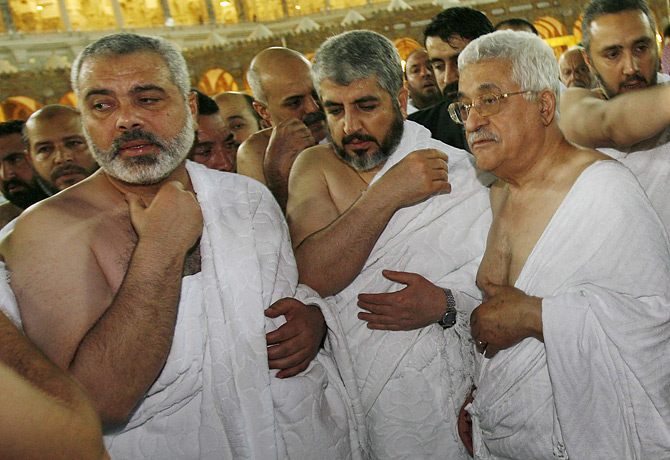
Palestinian Authority [PA] President Mahmoud Abbas has once again surprised Israel and the U.S. Administration, this time by signing a "reconciliation" agreement with Hamas.
On April 23, Abbas dispatched a high-level delegation of PLO officials to the Gaza Strip to sign the "historic" deal with Hamas Prime Minister Ismail Haniyeh.
The deal calls for the formation of a Palestinian unity government, headed by Abbas, within five weeks.

PIP: Hamas MP confirms that Hamas will never recognize Israel

ELDER OF ZIYON


The Hamas mouthpiece Palestine Information Center has an exclusive interview with Hamas sheikh and MP Hassan Youssef, where he confirms that Hamas will never recognize Israel.

Reacting to statements by PLO officials that a unity government will recognize Israel and be against terrorism, and that even Hamas will recognize Israel, Youssef asked rhetorically, "Does it make sense to ask [Hamas] to recognize Israel? The concept has nothing to do with logic and righteousness."

Report: Netanyahu agreed to talk borders, settlement freeze just before Hamas-Fatah deal

 JPOST.COM STAFF
04/25/2014 

Channel 10 reported that the premier gave his negotiators permission to sketch the boundaries of a future Palestinian state just before the Palestinian reconciliation deal was announced.


Israel on Thursday was surprised and infuriated by the reconciliation agreement between Hamas and Fatah particularly since hours earlier Prime Minister Binyamin Netanyahu had for the first time agreed to enter substantive negotiations with the Palestinian Authority over the borders of a future Palestinian state, Channel 10 is reporting on Friday.
Aides to the prime minister are denying the Channel 10 report.
According to Channel 10, while Netanyahu refused Palestinian demands to explicitly present his position on borders, he did give consent to his government's chief representatives in the negotiations - Justice Minister Tzipi Livni and attorney Yitzhak Molcho - to present maps on which both sides would then proceed to sketch the contours of the political boundary that would separate Israel and a yet-to-be-created Palestine.
The prime minister also agreed to a freeze of all new construction in the Jewish settlements of Judea and Samaria, though he insisted that Israel would complete all construction that has already been initiated, according to Channel 10.

PIP: Hamas TV celebrates jihad murder of Israelis: “Our harvest is your heads”


Now that Hamas and the PLO have reconciled, it ought to be understood that this is the general view that prevails among the entire “Palestinian” leadership. However, no doubt the fantasy will persist that the PLO/Fatah/the Palestinian Authority is “moderate,” while Hamas is “extremist.”

“Hamas TV celebrates killing: Our harvest is your heads,’” by Itamar Marcus and Nan Jacques Zilberdik, Palestinian Media Watch, April 24, 2014:
A video broadcast on Hamas’ Al-Aqsa TV yesterday shows actors playing Israeli soldiers entering the Gaza Strip, as a text on screen warns, “You will end up in Hell.” One by one the actor-soldiers are shot in the head, after which a Hamas sniper collects all the dog tags of the killed soldiers. A text appears on the screen: “Our harvest is your heads.”
Palestinian Media Watch reported that during the Gaza War, Hamas broadcast numerous TV clips celebrating the killing of Israeli soldiers and civilians.
Although the world was surprised by the unity agreement announced yesterday between Hamas and Fatah, the official PA daily had already reported nine days ago that Hamas leader Ismail Haniyeh announced a unity agreement was about to be finalized and implemented. In addition the Hamas head reiterated that kidnapping Israeli soldiers continues to be Hamas policy.
The following is the text in the official PA daily from April 16, 2014:

COP: Naval round-up as peace continues to break out all over

If there’s big news in the arcane world of naval operations, it might be that the Russian aircraft carrier, Admiral Kuznetsov, has supposedly departed the Mediterranean to head for home.
Regional postures
Then again, it might not.  The Aviationist reports that there are still Notices to Airmen (NOTAMs) effective in the Western Med that indicate an area where Kuznetsov plans to conduct flight operations.  The NOTAMs are in effect through 26 April – although Russian media reported on 18 April that Kuznetsov had completed her mission in the Med and was heading home.  It’s not clear why the Russians would have reported the carrier’s movements deceptively.  (NATO navies know where Kuznetsov has been throughout this period.)  It could be that they just changed their minds.
There are several things to say about Kuznetsov’s presence, and you can decide for yourselves what the import of the move is.  For one thing, Russia’s ability to keep the carrier deployed forward is bounded by the limitations of Russia’s basing and support arrangements in the Med.  Kuznetsov has been deployed since December, and her deployments since she began going to the Med again, in 2008, have typically been of about the same duration.  They are much shorter, in other words, than the deployments of U.S. aircraft carriers.  (USS Harry S Truman (CVN-75), for example, was deployed from July 2013 until this past Friday, 18 April.)  America has a far more extensive network of shore-based support capabilities than Russia has in the Med.
Admiral Kuznetsov anchored off Limassol, Cyprus in April 2014 (Image via defencenet.gr)
For another thing, however, the U.S. hasn’t been keeping a carrier in the Med.  What the U.S. hasn’t been doing, in fact, is the main factor affecting the decisions of Russia and other countries in the “Great Crossroads” area, at the juncture of Europe, Asia, and Africa.
At the operational level, Kuznetsov’s combat power and utility are minimal for any true military purpose, in Russia’s major foreign-policy concerns in the region right now, Ukraine and Syria.  (Kuznetsov could, in any case, be gotten into the Black Sea only by breaching the Montreux Convention – and Turkey wouldn’t sit still for that.)  The carrier’s presence in the Eastern Med, where she was for nearly three months, is certainly not meaningless.  But it’s politically demonstrative rather than militarily decisive.  And if there’s no U.S. carrier prowling the Med, the need for demonstration can be accorded a lower priority.
At the geopolitical level, U.S. passivity is equally important, if not more.  There are no new patterns developing in any of the hot spots around the Great Crossroads.  There’s nothing new about the method by which Russia is engulfing eastern Ukraine; the Russian tactics there are just Bolshevism with cell phones.  Bolshevism “works” not because it’s uniquely effective in terms of methods or tactics, but because it attacks where it’s most likely to go unopposed by a stronger power.
That’s exactly what’s happening in Ukraine.  The decisive factor isn’t anything the Russians are doing.  It’s the lack of opposition from the U.S. and NATO.  Even the shaky interim government in Kiev could, and probably would, be doing more to defend its territory if it knew it had backing from NATO against the conventional power Russia can bring to bear.  But it doesn’t.
The same dynamic is in play in Syria, and it’s in this overall context that all Russian moves have to be seen. If Russia is sending the carrier home now, it’s because it’s convenient – it keeps her navy and its budget on schedule – and nothing constrains her to do otherwise.
The Black Sea
USS Donald Cook (DDG-75), which had the encounter with the Russian Su-24 Fencer on 12 April, has just departed the Black Sea.  Her departure is unrelated to the incident with the Su-24; the U.S. and France are rotating combatants through the Black Sea to maintain a demonstrative NATO naval presence there.  The frigate USS Taylor (FFG-50), which had the unfortunate event with the propeller shaft grounding in the Black Sea in February, has just reentered the Black Sea, and the French frigate FS Dupleix (D641) is declared for an inbound transit of the Bosporus on 26-27 April.  (The NATO navies will be restricting their ships’ visits to the Black Sea to 21 days or less, in compliance with the Montreux Convention.)
The NATO warships represent the highest level of excellence for their kind, of course.  Nevertheless, claims that they signify a big military build-up by NATO are vastly overblown.  There is virtually no maritime character to the Ukraine conflict, and the three ships are not militarily useful for projecting power ashore, in any way that would be meaningful.  They are there to demonstrate NATO’s political interest, not to counter military moves by Russia (a purpose for which they are unsuitable).
Is it wise to signal political interest using military assets that have little to no military utility in the context they’ve been deployed in?  We report, you decide.
Turkish Maritime Task Group
The ships of the Turkish Maritime Task Group continue their progress in circumnavigating Africa, something the Turkish navy hasn’t done since 1866, when it was the Ottoman navy.  So far they have visited Tunisia, the Canary Islands, and Senegal (see here), Mauritania, The Gambia, Ghana, and Benin.
They’ve also visited Nigeria, and will pull into Namibia for a port visit at the beginning of May.  During the Nigerian visit, the Turks reportedly “donated” a warship to the Nigerian navy.  I can find no record of which warship (i.e., what type it was), but I assume it was a smaller patrol craft.  Interestingly, in mid-March, unconfirmed reporting suggested that arms had been shipped to unknown recipients in Nigeria via Turkish Airlines, a claim vigorously rejected by the Erdogan government.  An airline spokesman later said that the arms had been part of a legitimate shipment to the Nigerian navy.  Which doesn’t fit with the protestations from the Turkish government, so you see the conundrum here.
Turkish frigate TCG Gediz, an ex-US Oliver Hazard Perry-class frigate, hosts Mauritanian guests in Nouakchott on 2 April 2014 (Turkish navy image)
In conjunction with the visit to Nigeria, the Turkish warships participated in a multinational naval exercise as well, Obangame Express 2014.  This exercise series, sponsored by U.S. Africa Command and the host nation, focuses on joint maritime security and antipiracy training.  The 2014 iteration saw the Turkish navy’s first at-sea participation with its own warships.
The Iranian enigma
Many readers are no doubt aware of the Iranian navy’s announcement last week that its previously proclaimed plans to send warships to the Atlantic were on hold.  The “29th Fleet,” of which – depending on the report – the two formerly Atlantic-bound ships formed either all or part, would not be going to the Atlantic after all.
It remains the case that Iran is not being forthcoming about this, and that her ships have probably been somewhere other than where the Iranian navy has suggested they were.  Once again, a few days ago, the Iranian navy announced that the two ships in question, the frigate Sabalan and the replenishment ship Kharg, were conducting a port visit in the region.  This time, the port was supposedly Muscat, Oman.  And once again, there has been no independent evidence that the ships were there.
Iran has intimated vaguely that the antipiracy mission ended up taking precedence for the 29th Fleet over the planned voyage to the Atlantic.  But in three months of deployment, there has been not a single scrap of evidence that the Iranian warships were in the antipiracy patrol area in the Gulf of Aden or Red Sea.  With ships and reconnaissance planes from multiple NATO countries, along with the forces of China, Russia, India, Japan, South Korea, Australia, New Zealand, and Singapore, plying the same waters, it is simply not credible to propose that the Iranian warships, which were supposed to be in the Atlantic, were in the Horn of Africa instead for three months, but went unnoticed and unreported.
The latest Iranian announcement is timed to account for an on-schedule return to the ships’ home port of Bandar Abbas.  What have the ships been doing?  There is little to go on.  The ships have apparently been in an area or areas where they were very unlikely to be photographed or reported on.  Highly trafficked and better-wired locations around the Indian Ocean are unlikely stowaway spots: Sri Lanka, the Seychelles, the Maldives, the Mozambique Channel (where South Africa and Mozambique run a joint antipiracy operation of their own, Operation Copper).  Moving from one place to another, meanwhile, is more likely than remaining in a single place.
Presumably, the ships’ mission was related to Iran’s highest policy priorities.  Among those, her nuclear program and her arms shipments to terrorists might obviously benefit from the transshipment services of naval vessels (which cannot be stopped on the high seas except as a belligerent act).  As discussed here, Iran has been caught out, over the past decade, in increasingly elaborate transshipment schemes to get arms to Hamas and Hezbollah.  Perhaps some shipments are worth exceptional furtiveness and misdirection.  Securing uranium from African sources might also warrant such operations, or importing highly sensitive items from North Korea, via multiple interim stops.
We aren’t likely to know any time soon.  But we do have the prospect of repeating this whole drama in the near future, with Iran’s promise that the 30th Fleet (see link above) really will go to the Atlantic.
Russian – and Japanese – ships do Pakistan
File this one with the growing pile of “firsts.”  Ships of the Russian navy arrived in Karachi, Pakistan over the weekend for the first such port visit in modern history.  It reportedly included an at-sea drill between the navies, along with the usual diplomatic events.  The three-ship task group, which includes Udaloy-class destroyer Marshal Shaposhnikov, a naval tanker, and a salvage tug, is from the Pacific Ocean Fleet and left Vladivostok in March.
On the way to Pakistan, the Russian group participated in Exercise Komodo 2014, hosted by Indonesia, along with ships from 15 other nations, including the U.S., China, India, and Japan.
The Japanese warships visiting at the same time were two destroyers, Samidare (DD-106) and Sazanami (DD-113).  They’re on the way home from antipiracy ops off Somalia – and we are right to read something into the mutual comfort of the three nations with each other’s company.
Pakistani navy musters a reception contingent in Karachi for JDS Sazanami, a Japanese destroyer, in April 2014 (Pakistani navy image)
Pakistan’s sudden wild popularity has a lot to do with Asian alarm about China – Pakistan’s longstanding patron – but is also connected with the long view of where Asian relations are going in a post-Pax Americana world.  In less than a year, U.S. forces will be all but gone from Afghanistan, and the meaning of the American presence in the Persian Gulf, as well as U.S. relations with Pakistan, will inevitably change.  By January 2017, we will not be living in the same world.
Russian tug saga off U.S. coast
Speaking of the Russian navy, remember the Nikolay Chiker?  She’s the large-capacity, ocean-going Russian navy tug that was lurking off the Florida coast in March, before heading down to Curacao.  She’s been lurking again.  She was detected sitting off St. Eustatius in the Caribbean 5-6 April, and in port Havana 20-22 April.  Between times, Nikolay Chiker meandered around off Canaveral.  Her latest position on the 24th puts her south of western Cuba.
It bears repeating that the big tug is not outfitted for intelligence collection against rocket and space launches.  There may have been interesting events in these categories while she was there, in either March or April, but there’s nothing Nikolay Chiker can do about them.  If she has been fitted with equipment for special collection of some kind, it’s more likely to be underwater collection.
New agreement among Asian-Pacific nations on sea encounters
Members of the Western Pacific Naval Symposium (WPNS) came to a landmark agreement this week on a Code for Unplanned Encounters at Sea (CUES), which – at a very basic level – will regularize the behavior expected on both sides in routine, unplanned maritime encounters between the member navies.
The U.S. and 20 other nations (including Russia and China) are members of WPNS, a non-treaty consultative body which held its first symposium in 1988.  The CUES agreement is non-binding, and, again, is very basic.  It is not an “incidents at sea” (INCSEA) type agreement, like the one signed by the U.S. and former USSR in 1972.  An INCSEA agreement of some kind is what many observers have been advocating for relations in the South China Sea, especially in the flurry after the Chinese navy’s incident with the cruiser USS Cowpens (CG-63) in December 2013.
But it’s something.  The final text of the CUES agreement has not been made public yet, but you can view some of its provisions as reported in Chinese (English-language) media here.  (China hosted the symposium this past week.)
It remains to be seen how much of an achievement CUES is as a measure to promote stability, security, and peace.  I have a strict policy of not sneezing at these earnest, hard-negotiated conventions.  But they tend to proliferate when storm clouds are gathering, without damping down the underlying reasons for confrontation.  Procedure isn’t a substitute for policy or will.
J.E. Dyer is a retired Naval Intelligence officer who lives in Southern California, blogging as The Optimistic Conservative for domestic tranquility and world peace. Her articles have appeared at Hot Air, Commentary’s Contentions, Patheos, The Daily Caller, The Jewish Press, and The Weekly Standard.
More by

Read more at http://libertyunyielding.com/2014/04/25/naval-round-peace-continues-break/#mMqg63ShRhldxFts.99If there’s big news in the arcane world of naval operations, it might be that the Russian aircraft carrier, Admiral Kuznetsov, has supposedly departed the Mediterranean to head for home.
Regional postures
Then again, it might not.  The Aviationist reports that there are still Notices to Airmen (NOTAMs) effective in the Western Med that indicate an area where Kuznetsov plans to conduct flight operations.  The NOTAMs are in effect through 26 April – although Russian media reported on 18 April that Kuznetsov had completed her mission in the Med and was heading home.  It’s not clear why the Russians would have reported the carrier’s movements deceptively.  (NATO navies know where Kuznetsov has been throughout this period.)  It could be that they just changed their minds.
There are several things to say about Kuznetsov’s presence, and you can decide for yourselves what the import of the move is.  For one thing, Russia’s ability to keep the carrier deployed forward is bounded by the limitations of Russia’s basing and support arrangements in the Med.  Kuznetsov has been deployed since December, and her deployments since she began going to the Med again, in 2008, have typically been of about the same duration.  They are much shorter, in other words, than the deployments of U.S. aircraft carriers.  (USS Harry S Truman (CVN-75), for example, was deployed from July 2013 until this past Friday, 18 April.)  America has a far more extensive network of shore-based support capabilities than Russia has in the Med.

Admiral Kuznetsov anchored off Limassol, Cyprus in April 2014 (Image via defencenet.gr)
For another thing, however, the U.S. hasn’t been keeping a carrier in the Med.  What the U.S. hasn’t been doing, in fact, is the main factor affecting the decisions of Russia and other countries in the “Great Crossroads” area, at the juncture of Europe, Asia, and Africa.

Time for consequences

Caroline Glick


Abbas Hamas


It’s hard not to admire Palestinian Authority President Mahmoud Abbas’s brazenness.

Two weeks ago, Abbas signed on to 15 international agreements that among other things require the PA to respect human rights and punish war criminals.

And this week, he signed a unity deal with two genocidal terror groups all of whose leaders are war criminals. Every leader of Hamas and Islamic Jihad, the two parties that signed the deal with the PLO, are war criminals. Under the Geneva Conventions, which Abbas signed onto just a couple of weeks ago, he is required to put them on trial, for their war crimes.

Here it is worth noting that under the Geneva Conventions, every single rocket launch from Gaza into Israeli territory is a separate war crime.

Abbas was only able to sign the Geneva Conventions on the one hand, and the unity deal with terrorist war criminals on the other, because he is utterly convinced that neither the US nor the European Union will hold him accountable for his actions. He is completely certain that neither the Americans nor the Europeans are serious about their professed commitments to upholding international law.

Who are the Victims and Who Are the Victimizers?


One year after the bombs went off at the Boston marathon, Brandeis authorities were so intent on avoiding the issues those bombs had raised, that they would rather point the finger at a critic of the radical ideology than do anything to criticize the ideology.
Is not the Palestinian leadership a viable negotiating partner with whom peace is just about to be achieved? How do you protest if the protesters are Muslims? Who are the victims and who are the victimizers? After all, "victims" cannot victimize, can they?
When we see a global bigotry and hatred such as this, we should identify it as such and demand, in the name of all that is decent, that it stop.
The great Western disease of today -- there could be quite a competition for that one -- is probably denial. Denial now runs right through the Western way of looking at the world. It is just unfortunate for us that it does not run through the rest of the world in the same way.
Take three recent examples, one in America, one in Britain and one absolutely everywhere.
One year ago, two young male immigrants to America -- to whom America had given absolutely everything -- repaid the favor by planting bombs at the finish line of the Boston Marathon. Their victims included an eight year old boy. This atrocity was carried out because the young men had absorbed the grievance culture and violent radicalism of a form of Islam, a strain of thinking that has not gone wholly undocumented in recent years.

The Trouble with Gaza


The trouble for Hamas is that it is not alone. With the aid of Iranian funds and training, Islamic Jihad has built up a fighting force of 5,000 guerrillas with over 2,000 rockets. Those numbers are growing.
These groups are, it seems, outraged by what they see as Hamas's soft policy on Israel, and have pledged soon to resume hostilities against it.
Under the rule of the Hamas regime, the Gaza Strip has transformed itself in recent years into one of the world's most active terrorist havens, and this radical enclave is destined to burst.
Currently, Israel's government and defense establishment are choosing to contain, rather than uproot, the extensive terrorist infrastructure that has taken root in the Hamas-run enclave.
Hamas is so far cooperating with this approach. It is seeking to expand its local rocket production industry; increase the number of its gunmen, and consolidate its grip on power. All of these long-range goals require time and stability.
Israeli defense officials have acknowledged, however, that containment is a time-limited tactic.

A Hamas military parade in Gaza.

In addition to Hamas, Gaza hosts an array of radical Islamist armed organizations, such as Iran's direct proxy, Islamic Jihad, and a growing assortment of armed groups affiliated with Al-Qaeda -- all of which reject the legitimacy of a truce with Israel, and which seek to challenge it.

Defining 'Pro-Israel' Is Not Rocket Science

Mitchell G. Bard
For the last several years the Jewish community has wasted thousands of hours in a sterile debate regarding the "big tent," and the criteria for deciding who should be inside or outside. It's time to throw away the tent analogy and lay out the requirements for recognizing a person or organization as pro-Israel in the American context.
Today, there are groups who hold the contradictory positions that their criticism of Israel helps the Jewish state, that presenting a cacophony of voices to U.S. policymakers rather than a unified position strengthens U.S.-Israel relations and that American Jews -- who do not serve in the IDF or have to live with the consequences of their prescriptions -- know what's best for Israel and need to save Israel from itself. This last position is particularly disturbing because it is both paternalistic and anti-Democratic. Those who want the U.S. to impose their preferred policies on Israel assume that Israelis are too stupid or immature to know what's best for their country. They also believe that Israel's democratically elected leaders are clueless as to Israel's interests and the fact that they represent the wishes of Israeli voters is irrelevant.

Abbas' fictional state


Palestinian Authority President Mahmoud Abbas has heard about the latest videotape by al-Qaida leader Ayman al-Zawahri, in which Zawahri calls Abbas a "traitor who is selling out Palestine," and has gotten cold feet.
But even without the tape, Abbas can imagine what the Islamists have in store for him, and his threat to "give the keys to the Palestinian Authority back to Israel" reflects the overall air of doom and gloom shared by him and his people over the crisis plaguing the peace talks.
Until recently Abbas and his people were under the impression that they would be able to leverage the pressure applied by the United States and European Union regarding the peace talks against Israel. The illusion of free achievements was backed by the Israeli Left's cries of gevald, fearing a "third intifada," a "boycott," or a "binational state."

Islam’s Religious War with Everyone

Islam did not expand by treating minorities well. It grew through genocide, slavery and war. That is still how it is growing today.
Few divides are as impossible to bridge as those of religion. You either believe or you don’t.
When it comes to Islam, non-Muslims are expected to take its goodwill on faith. If you believe your eyes and ears, Islam and violence go together like peanut butter and jelly. But if you believe Muslims and their spin doctors with academic degrees, Muslims are the victims of other religions.
If Muslims fighting Christians, Jews, Hindus and Buddhists are the victims of non-Muslims, what are we to make of Muslims fighting other Muslims in Syria, Lebanon and Iraq? Religious civil wars make it hard to believe that Muslims are the victims of other religions instead of the authors of their own violence.

Israel slams 'weak' U.S. response to Fatah-Hamas unity deal

Senior official in Jerusalem: 'Americans need to tell Abbas this is a red line - he can't associate with Hamas.'


Israel is disappointed with the 'weak' American reaction to the reconciliation agreement between Fatah and Hamas, and demands a clearer, more resolute response, a senior Israeli official involved in the dialogue with Washington told Haaretz on Thursday.
Government ministers discussed the international response to the unity agreement at the five-hour security cabinet meeting that dealt with the Palestinian pact that was reached on Wednesday. According to the senior official, ministers were in full agreement that the American response was "insufficient, weak, merely for show and didn't include enough exclamation marks."
After the reconciliation deal was announced, U.S. State Department spokeswoman Jennifer Psakicalled the deal "troubling" and said the United States was "disappointed" by it. She added that Washington would ask the Palestinians to provide clarifications.

Thursday, April 24, 2014

Waiting for the Palestinian Godot‏

Why are we repeatedly surprised every time Mahmoud Abbas fails to sign a peace agreement with Israel? 

By Ari Shavit | Apr. 24, 2014 

http://www.haaretz.com/opinion/1.586945

There are some moments a journalist will never forget. In early 1997, Yossi Beilin decided to trust me, and show me the document that proved that peace was within reach. The then-prominent and creative politician from the Labor movement opened up a safe, took out a stack of printed pages, and laid them down on the table like a player with a winning poker hand.
Rumors were rife about the Beilin-Abu Mazen agreement, but only a few had the opportunity to see the document with their own eyes or hold it in their hands. I was one of those few. With mouth agape I read the comprehensive outline for peace that had been formulated 18 months earlier by two brilliant champions of peace -- one, Israeli, and one, Palestinian. The document left nothing to chance: Mahmoud Abbas is ready to sign a permanent agreement. The refugee from Safed had overcome the ghosts of the past and the ideas of the past, and was willing to build a joint Israeli-Palestinian future, based on coexistence. If we could only get out from under the Likud’s thumb, and get Benjamin Netanyahu out of office, he will join us, hand in hand, walking toward the two-state solution. Abbas is a serious partner for true peace, the one with whom we can make a historic breakthrough toward reconciliation.

National Intel Misled Congress About Brotherhood Contacts

Newly declassified documents obtained by the Clarion Project show that the Office of the Director of National Intelligence (ODNI) misled members of Congress in 2012 about its involvement with Muslim Brotherhood-linked entities.
Further, the documents show that there were even a number of internal communications within the Office of the Director of National Intelligence expressing concerns about the Brotherhood links of these entities.
The story of the deception began when the Director of National Intelligence James Clapper testified to Congress on February 10, 2011 saying that the Muslim Brotherhood is “a very heterogeneous group, largely secular, which has eschewed violence and has described Al-Qaeda as a perversion of Islam.”

Tony Blair: Fighting Islamism – A Defining Challenge of Our Time


Thu, April 24, 2014
Tony Blair, the Former British Prime Minister, delivered a keynote speech at Bloomberg HQ in London entitled 'Why the Middle East Still Matters.' In it he described radical Islam as the greatest threat facing the world today.
He argued "there are four reasons why the Middle East remains of central importance and cannot be relegated to the second order."
The first three: oil, proximity to Europe and Israel, whilst important, were not the focus of the speech. Blair rapidly moved on to the fourth and most important reason: Islamic extremism also known asIslamism.

PIP: Hamas TV clip: "Our harvest is your heads" - Hamas TV celebrates killing Israeli soldiers

Hamas leader Haniyeh announced 9 days ago:
Hamas policy is to kidnap Israeli soldiers

Haniyeh announced 9 days ago that the unity agreement with Fatah was imminent

by Itamar Marcus and Nan Jacques Zilberdik

A video broadcast on Hamas' Al-Aqsa TV yesterday shows actors playing Israeli soldiers entering the Gaza Strip, as atext on screen warns, "You will end up in Hell." One by one the actor-soldiers are shot in the head, after which a Hamas sniper collects all the dog tags of the killed soldiers. A text appears on the screen:  "Our harvest is your heads."
(Sniper picks up soldiers' dog tags)


A match made in heaven?

Over the past year Palestinian Authority President Mahmoud Abbas has stood strong on two legs. The first leg has been negotiations with Israel, and the second, reconciliation talks with Hamas. This is also the reason for the Catch-22 in which he has found himself: He would need to concede one of these legs, but walking on one leg alone would lead to his downfall. He chose, therefore, to remain in place, to conduct negotiations with Israel and Hamas but not to move ahead in either.
And yet Abbas decided to go forward with Hamas regardless, and risk Israeli countermeasures. Still, his agreement with the Hamas leadership should be treated with caution and skepticism. Similar deals reached by the sides in the past were repeatedly violated, and the most recent Palestinian unity government, established in early 2006, came crashing down with Hamas' hostile takeover in Gaza, while Abbas moved to erase Hamas' foothold in the West Bank. Regardless, after nearly a decade of fruitless talks, the sides have struck the deal they had been unwilling to accept. They signed the deal, therefore, due to a lack of other options, and as stated, it is doubtful the sides will uphold it.